The different types of furniture
The stool
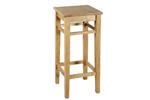
A stool is a seat with three or four legs, usually without a back. Special
stools exist for pianists or various trades or activities; some
models designed for milking cows had only one or two legs.
The chair
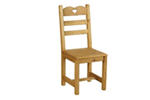
A chair is a type of furniture designed for a person to sit on; it consists of a backrest, sometimes arms, and usually four legs to support the seat, which is raised above the ground. A chair for more than one person is a bench. Often the backrest does not extend to the seat, allowing for ventilation. The backrest and sometimes the seat are openwork for decoration and ventilation. The backrest sometimes extends above head height.
A chair includes:
• a base, generally composed of four legs, sometimes reinforced by a
stretcher;
• a seat, the seat depth of a chair is between 45 and 55 cm;
• a backrest, sometimes extended by an armrest.
The armchair and the sofa
An armchair is a seat with a backrest and armrests.
An armchair consists of:
• A base: generally composed of four legs, sometimes reinforced by a
stretcher
An armchair is traditionally made or restored by hand by an
upholsterer. There are also mass-produced copies; these often use
synthetic foams as padding, unlike traditional armchairs which are
normally made with horsehair and springs.
A sofa, couch, or divan is a comfortable piece of furniture with
several seats and usually an armrest on each side. Sofas are
generally found in the living room or lounge. They can be made of
various fabrics or leather.
The bed
The confidant and the indiscreet one
The table (dining room)
The coffee table
The console
The pedestal table
The nightstand
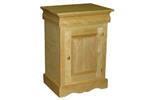
A bedside table (or nightstand) is a small piece of furniture placed
next to a bed, at head height, and designed to hold useful items for
a night's sleep, just before going to bed, or upon waking: alarm
clock, lamp, glasses, telephone, book, glass of water, medication,
etc. The height of a bedside table generally does not exceed that
which one can reach while lying in bed, and it may be equipped with
storage such as shelves, drawers, or compartments closed by doors.
The bedside table is sometimes integrated into the bed, particularly
in the case of bunk beds.
The dresser
The buffet
The Chest
The Dresser
The wardrobe
The library and the display case
The office and the secretary
The ragpicker and the weekly planner
The hairdressing Table
The Cabinet
As with richly decorated furniture, some of its panels were often
removed and sold separately as works of art in their own right.
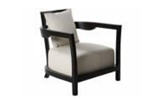
• A seat: the seat depth of an armchair is between 50 and 55 cm
• A backrest
• Armrests (arms): which may be openwork or upholstered, with or without arm
pads. The space between them is approximately 55 cm and is located
at a height of 60 cm from the floor.
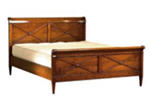
A bed is a piece of furniture used primarily for sleeping, and therefore
generally placed in a bedroom where it is the defining piece of
furniture. We lie down on it to relax or rest, and we also sit on it
to read.
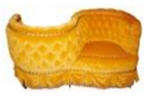
The confidant or the opposite is a double armchair in an S-shape that allows
two people to talk without having to turn their heads. This type of
furniture was invented in the 19th century.
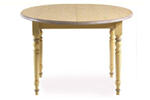
A table is a type of furniture, originally consisting of a flat, horizontal
surface (assembled wooden planks) designed to be placed on one or
more legs, trestles, or supports. It is generally used for meals. It
may be equipped with one or more drawers and have extension leaves.
It comes in many shapes and sizes.
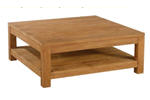
A coffee table, or living room table, is a type of table low enough to be
reached while seated (hence the name), and is intended to be placed
in a living room or sitting room, within easy reach of people on the
sofa and armchairs, so they can place on it what they need while
seated. A coffee table may be equipped with storage space such as
drawers or shelves.
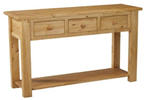
In architecture, a console is a piece, usually S-shaped, used to support a
balcony or projecting element. In cabinetmaking, a console is a
shallow table with one or more legs, generally used for decorative
purposes.
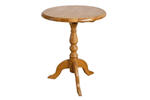
A guéridon is generally a round table with a single central leg or column.
Some variations have several legs. This type of furniture appeared
in France around the mid-17th century. The tabletops are often
supported by mythological, African, Greek, or Egyptian figures.
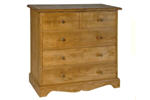
A chest of drawers is a low piece of furniture with wide drawers for storing
linens or various other items. The chest of drawers appeared at the
end of the 17th century. It acquired its current name in 1708 and
became the most widely manufactured piece of furniture.
The sideboard is a very common piece of furniture that exists in many
regional variations. It can be a low cabinet with two or three doors
and possibly drawers, or a low cabinet with a shorter upper section.
Usually, dishes are stored at the bottom and glasses at the top.
Sometimes sideboards are called buffets, and during the Renaissance, the
appropriate term for displaying dishes was the dresser.
Synonyms for sideboard include: silver cabinet, sideboard, credence
table, serving table, and dresser (or dresse).
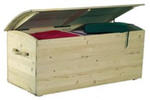
A chest is a closed piece of furniture designed to contain or protect
objects, and may also allow for their transport. It can also serve
as a seat, with or without a backrest, and may also have drawer(s).
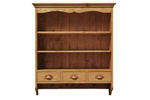
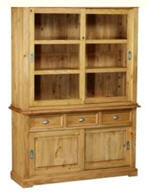
A dresser is a rustic piece of furniture consisting, in its upper section,
of shelves on which tableware is displayed. It can be combined with
a sideboard and then becomes a "double-bodied" piece of furniture,
or "dresser-sideboard".
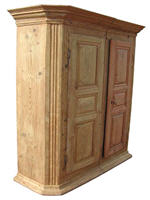
A wardrobe is a closed piece of furniture designed to store objects,
especially clothing and linens, in a home. It is most often placed
in the bedroom. A wardrobe is generally tall, made of a single unit,
and equipped with doors, shelves, and often hanging rails, and
sometimes topped with a cornice. When the doors have mirrors, it is
called a wardrobe with a mirror. Wardrobes appeared in the 16th
century in the form of two-door or four-door cabinets called chests.
Traditional wardrobes have been superseded in modern homes by the
widespread use of closets, often planned from the outset.
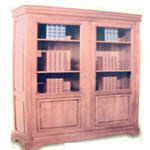
A bookcase (from the Ancient Greek βιβλιοθήκη: biblio, "book"; thêkê,
"place") is an organized collection of books.
This piece of furniture is designed to hold books, whether classified or
not. Being shallow, it allows for an overview of the various titles
in the collection.
A display case is used to showcase objects (collections), highlighting their
contents through the use of light (glass).
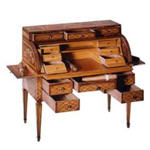
The word "bureau" (office) derives from the Old French "burel," which
referred to a coarse cloth in the Middle Ages. Later, it came to
designate a mat on which accounts were kept, and then the table used
for this purpose. The office took on various forms from the 17th
century onward: cabinet, Mazarin desk, slant-front desk, back desk,
secretary desk, American desk, etc. The word eventually came to
designate a room or even a business. It is an organized piece of
furniture, with drawers and various storage compartments (filing
cabinets, folders, etc.). It includes a work surface, which is now
generally used to place a computer.
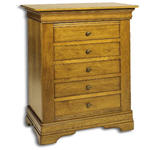
The chiffonier is a chest of drawers that appeared during the Regency
period.
It is designed for storing linens. It is usually taller than it is wide and
generally has a marble top.
The weekly organizer is a chest of drawers with seven drawers, one drawer
for each day of the week!
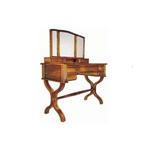
The dressing table is a piece of furniture that appeared during the Regency
period with the feminization of furniture. It is a practical piece
of furniture intended for grooming and storing related toiletries.
In classic styles (excluding contemporary ones), it typically takes
the form of a small desk with a central drawer and false drawer
fronts on the sides (usually two sets of two drawers to provide
ample depth). These false fronts conceal side compartments (which
can be fitted out and/or lined with textiles) accessible from the
top via drop-down doors. The fittings of these side compartments
must be removable for potential repairs.
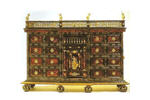
A cabinet is a piece of furniture whose entire front is covered in drawers.
Sometimes it features a base with twisted columns, an aesthetic
derived from architecture.
It appeared during the Renaissance, along with the Western table and the
two-part sideboard.
The most precious are veneered with ebony. It is the skill with this
material that defines the cabinetmaker. (It is traditionally the
most majestic of furniture.)